
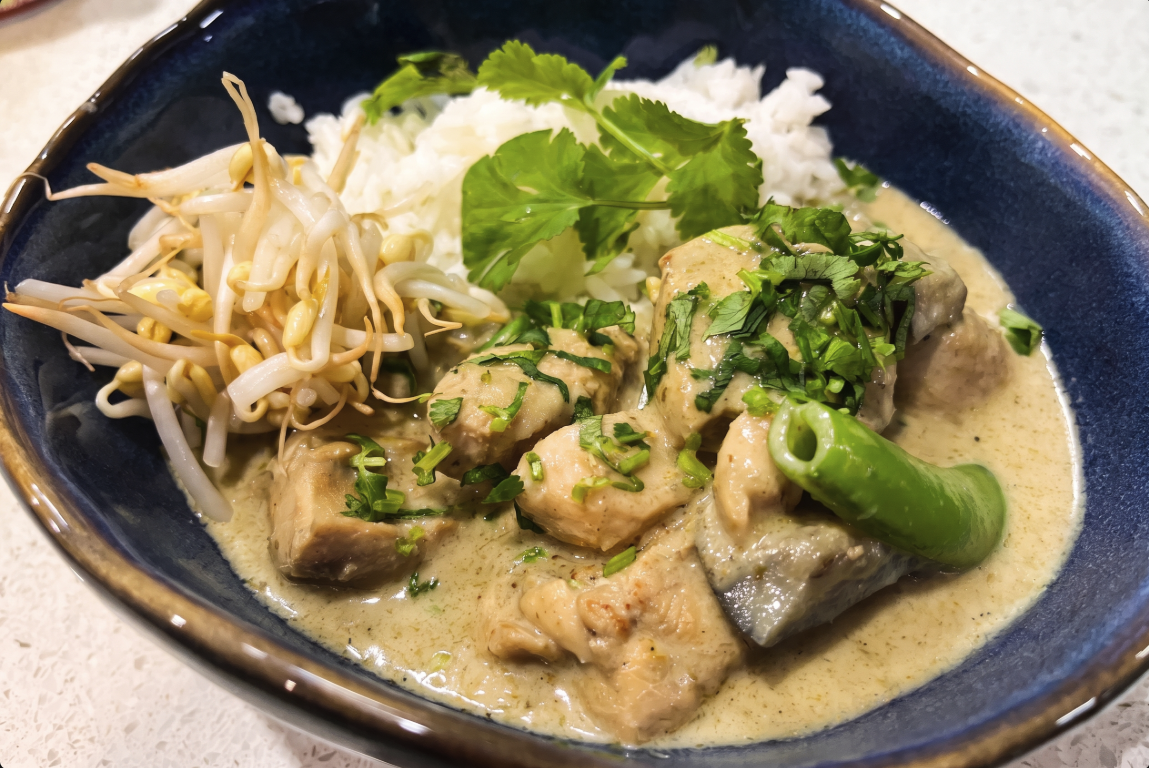
Thai green curry is all about balance.
You want the fragrance of the curry paste, the richness of coconut cream, the savoury depth of a good stock and enough freshness at the end to stop the sauce from feeling too heavy.
And, of course, you want the right amount of heat.
Kitchen Confidence members may remember the Thai Green Chicken Curry we made several months ago using whole chicken thighs in the Ninja Foodi. That version used the sauté and pressure cooker settings and produced a rich, deeply flavoured curry with chicken that softened beautifully in the sauce.
It was also quite hot.
This new version uses the same amount of Mae Ploy Green Curry Paste, but it is cooked in the wok with diced chicken breast, fresh vegetables and a gentler simmer.
The result was noticeably different.
The pressure-cooked curry had a stronger chilli heat, while this wok version was beautifully balanced and closer to a medium curry.
Same curry paste.
Similar ingredients.
A very different result in the bowl.
This is what makes cooking so interesting.
Recipes are not only shaped by the ingredients we use. The cooking method, temperature, timing and order in which ingredients are added can all change the final flavour.
Pressure cooking uses higher temperatures in a sealed environment. This can extract and distribute the chilli oils from the curry paste more thoroughly throughout the sauce.
The wok method is quicker and more open. The curry paste is still cooked properly to release its oils and fragrance, but the sauce is then gently simmered and finished with lime juice, crisp sugar snap peas, fresh bean sprouts and coriander.
Those fresh finishing ingredients help balance the richness and chilli heat.
It is a great reminder that following a recipe is only one part of cooking. Understanding what the cooking method is doing gives you much more control over the finished dish.
A fragrant and creamy Thai green curry with tender chicken breast, eggplant, sugar snap peas and a fresh lime finish.
This version is cooked entirely in the wok, making it a practical midweek meal while still teaching some important flavour-building techniques.
Serves: 3–4
Time: Approximately 30–35 minutes
Skill Level: Intermediate, but very achievable
Equipment: Wok or large deep frying pan
Place the wok over medium-high heat and allow it to become hot.
Add the vegetable oil.
Add the Mae Ploy Green Curry Paste and sauté until it becomes fragrant and begins to release its oils.
Do not rush this step.
👉 Chef’s Tip:
Cooking out the curry paste develops the flavour and removes the raw taste. Adding curry paste directly to liquid can leave the finished sauce tasting flat and underdeveloped.
Add the diced chicken breast and sauté until it is lightly coloured on all sides.
The chicken does not need to be completely cooked at this stage.
Pour in the Bone Roasters Chicken Stock and stir through the curry paste and chicken.
Cook for approximately 10 minutes.
Add the diced eggplant and coconut cream.
Reduce the heat and gently simmer for a further 10 minutes, or until the chicken is cooked through and the eggplant is tender.
👉 Chef’s Tip:
Once the coconut cream has been added, keep the curry at a gentle simmer. Boiling coconut cream too aggressively can cause the sauce to split.
Prepare a cornflour slurry by combining cornflour with a little cold water.
Briefly bring the curry sauce to the boil and gradually stir in enough slurry to reach your preferred consistency.
As soon as the sauce has thickened, reduce the heat again.
Add the lime juice and sugar snap peas.
Turn off the heat and allow the peas to warm through in the sauce without becoming soft.
The peas should remain bright, fresh and slightly crisp.
Serve the curry with steamed jasmine rice.
Garnish with the bean sprouts and freshly chopped coriander.
Offer sliced fresh chillies or sambal paste on the side for anyone who would like more heat.
Spoon steamed jasmine rice into the bowl.
Add the chicken, eggplant and sugar snap peas, then ladle the green curry sauce generously over the top.
Finish with:
The bean sprouts are added as a garnish rather than cooked into the curry so they retain their crunch and freshness.
This recipe helps build confidence with several important cooking techniques:
Many traditional Thai curry pastes include ingredients such as galangal, lemongrass, kaffir lime, chilli, garlic, shallots and shrimp paste.
Most home cooks do not have all of those ingredients sitting in the fridge, ready to grind into a fresh curry paste.
And that is perfectly fine.
Good cooking is not about making everything as complicated as possible. It is about understanding where flavour comes from and choosing ingredients that help you achieve a good result.
That is why Mae Ploy Green Curry Paste earns its place in the pantry.
There can be a belief that “proper” cooks must make every component of every dish from scratch.
Professional chefs know differently.
A good kitchen is not measured by how difficult it can make the cooking process. It is measured by the quality and consistency of the food it serves.
Mae Ploy is not simply a supermarket shortcut. It is a product widely supplied to professional kitchens because it provides a reliable and authentic Thai flavour base. Restaurants use it because it saves time, reduces waste and gives them consistency from one batch of curry to the next.
Chef Ian recently dined at Rice Boi in Mooloolaba, where the ingredients used in their dishes were proudly displayed - and there among them was a range of Mae Ploy products.
They were not hidden away as though using them was something to be embarrassed about.
They were displayed because good chefs understand the value of beginning with a dependable product and then knowing how to cook with it properly.
You can certainly make your own Thai green curry paste.
You will need to source ingredients such as green chillies, galangal, lemongrass, kaffir lime, garlic, shallots, spices and shrimp paste. Then you will need to prepare them, pound them in a mortar and pestle and achieve the correct balance of fragrance, salt, heat and acidity.
If that is something you would enjoy doing, absolutely give it a go.
But you do not need to do all of that every time you want a good Thai curry.
The real skill is knowing how to use the paste:
That is not taking a shortcut around good cooking.
That is cooking intelligently.
We sell the larger Mae Ploy tub because it offers better value and can be used for many meals.
Once opened, it will keep well in the refrigerator. You can also portion the paste into smaller amounts and freeze it, ready for another curry, soup, noodle dish or stir-fry.
You could even divide the tub with a friend.
This is the kind of pantry ingredient we like at Underground Chef:
Not clutter for the sake of it, but an ingredient that earns its place.
Coconut cream gives the curry richness, but it should not be expected to provide all the flavour.
Using Bone Roasters Chicken Stock gives the sauce a stronger savoury foundation and helps the curry taste fuller and more developed.
Water will create liquid.
A properly made chicken stock creates flavour.
It is a simple upgrade, but one that makes a noticeable difference to the finished dish.
The earlier Ninja version used whole bone-in chicken thighs, which suited pressure cooking beautifully.
The bone and skin added richness, while the pressure cooking softened the chicken until it was close to falling from the bone.
This wok version needs a different approach.
Diced chicken breast cooks quickly and evenly, making it ideal for a faster curry. It also produces a slightly lighter result than the whole chicken thighs.
The important thing is not to overcook it.
Colour the chicken first, then allow it to finish gently in the stock and coconut cream.
One of the strengths of this version is the contrast in textures.
The eggplant is added earlier because it needs time to soften and absorb the curry sauce.
The sugar snap peas are added at the very end so they retain their colour and bite.
The bean sprouts are used as a fresh garnish rather than being simmered in the sauce.
This gives you tender chicken and eggplant, balanced by crisp vegetables and fresh herbs.
That contrast stops the curry from becoming one soft, heavy bowl of food.
Coconut cream is rich, and curry paste can carry considerable heat.
Lime juice helps balance both.
Adding it towards the end brightens the sauce and cuts through the richness without overpowering the curry.
It is not there to make the curry taste strongly of lime. It is there to make the other flavours taste clearer and more balanced.
A good Thai green curry should not simply be hot.
You should still be able to taste the herbs, spices, coconut, stock, vegetables and chicken.
In this wok version, the same amount of curry paste produced a noticeably gentler result than the previous pressure-cooked curry.
That does not mean one method is right and the other is wrong.
They simply produce different results.
The pressure cooker gave us a deeper, richer and hotter curry.
The wok produced something fresher, lighter and more balanced.
This is exactly the kind of comparison that helps build Kitchen Confidence.
It is much easier to add extra heat than it is to remove it.
Rather than making the entire curry hotter, serve fresh sliced chillies or sambal paste on the side.
That allows each person to adjust their own bowl.
Those who prefer a medium curry can enjoy the balanced sauce as it is, while anyone wanting more fire can add it themselves.
A few key ingredients help make this curry work:
Provides the authentic Thai aromatic base without requiring you to prepare every ingredient from scratch.
Adds richness, body and the smooth coconut flavour needed to balance the curry paste.
Builds savoury depth and gives the sauce a more complete flavour.
Eggplant, sugar snap peas, bean sprouts, lime and coriander are widely available from supermarkets and fresh food markets.
Optional, but useful for allowing everyone to control the heat in their own bowl.
It’s not just a meal kit — it’s a cooking lesson in a box.
Did you make our previous pressure-cooker version using whole chicken thighs?
Think back to how you found the heat and flavour.
You could even cook both versions and compare them:
This is not about choosing a winner.
It is about tasting how different techniques affect the same core ingredients.
You do not need to make curry paste from scratch to cook a memorable Thai curry.
Use a good-quality paste, cook it out properly, build the sauce with a proper stock and coconut cream, then finish with freshness and acidity.
Most importantly, taste as you go and pay attention to how the cooking method changes the result.
The ingredients matter.
But what you do with them matters just as much.
Same paste. Different method. Different heat.
That is cooking.
Chef Ian