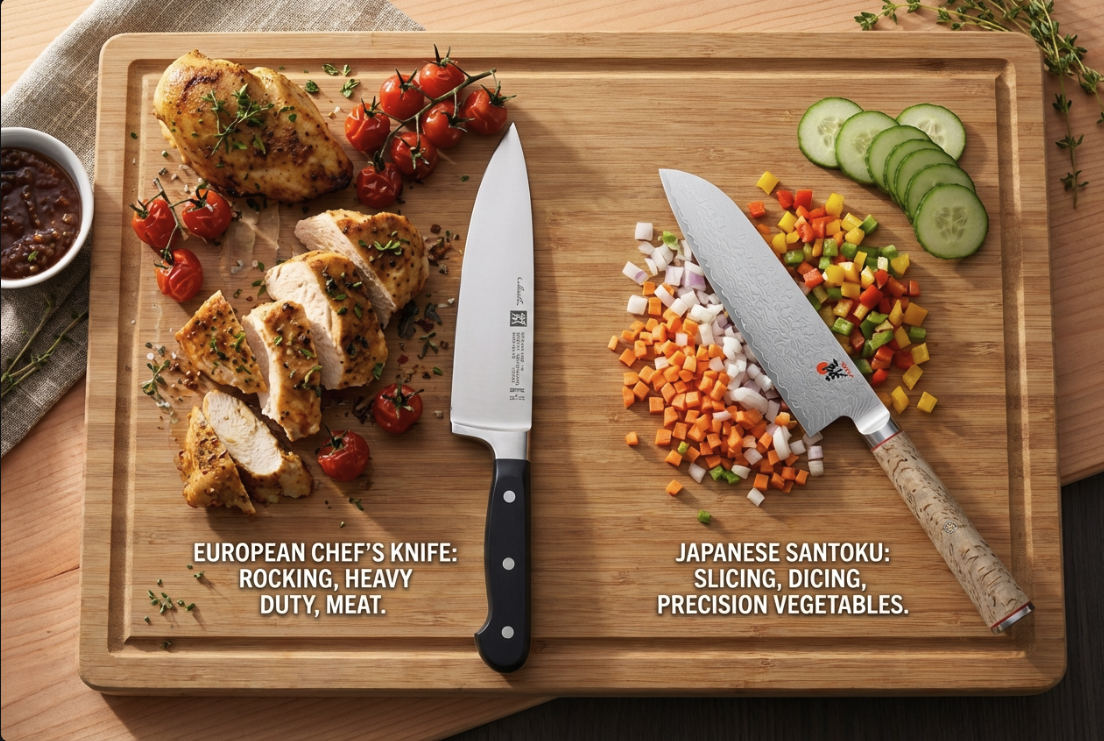
European vs Asian knives (and why you’ll love having both)
I get asked this all the time:
“Chef… which is better — a European chef’s knife or an Asian Santoku?”
Here’s the truth: you can’t compare them.
They’re apples and oranges — different tools built for different jobs.
And when you use the right one, prep gets faster, safer, and a whole lot more enjoyable.
The European chef’s knife
The everyday workhorse
A European cook’s knife is built for grunt work. It’s heavier, sturdy, and happy doing the tough stuff most home cooks face daily.
Best for:
- thick pumpkin skin and hard squash
- larger cuts of meat
- dense vegetables (sweet potato, cabbage, etc.)
- jobs that need weight and push power
Why it feels good:
That curved blade is made for a rocking motion, which makes repetitive prep smoother and easier.
The Santoku
Precision + finesse (the scalpel)
If the European knife is the workhorse, the Santoku is the precision tool. Lighter, thinner, and sharper, it’s designed for clean, controlled cutting.
Best for:
- precise vegetable slicing
- fine cuts (thin as you can manage)
- quick up-down chopping
- delicate jobs where control matters
Chef warning (said with love):
Don’t use a Santoku like a cleaver.
Take it to a pumpkin and you risk chipping that beautiful edge.
It’s not a competition — it’s a partnership
European vs Asian isn’t “better vs worse.”
It’s right tool, right job.
- European chef’s knife: durability, weight, power
- Santoku: speed, precision, finesse
Use the wrong knife and you fight the food (or damage the blade).
Use the right knife and suddenly prep feels… easy.
How I use them (real kitchen examples)
- Pumpkin / hard squash? European chef’s knife.
- Fine onion dice, herbs, tomato, cucumber? Santoku.
- Breaking down bigger meat cuts? European.
- Fast veg prep for stir-fries? Santoku.
- Anything you’re unsure about? Start with European for safety, then swap to Santoku for finesse.
Chef’s Tricks (the stuff that actually helps)
- Sharp beats expensive. A sharp mid-range knife cooks better than a blunt fancy one.
- Let the knife do the work. If you’re forcing it, it’s blunt or it’s the wrong tool.
- Don’t twist the Santoku in hard veg. Straight cuts, clean motion.
- Use a proper board. Glass boards wreck edges.
- Wash and dry. Don’t leave good knives soaking in the sink.
Final word from Chef Ian
"Choose the knife that suits the job — and let the tool do the work."
Chef Ian