In Hiroshima, a group of junior-high students uncovered one such story while working on a local history project. What they found would inspire their community — and eventually lead to a commemorative bench being built in a local park.
Their research led them to Cherry Parker (Nobuko Sakuramoto), remembered as the first Japanese war bride to come to Australia. Cherry fell in love with an Australian man, Gordon Parker, during a time when relationships between Japanese women and foreign men were not only uncommon, but often heavily scrutinised. Despite the difficulties, the couple’s love endured — a story of resilience, determination, and hope.
For the students, this discovery was transformative. “When the students started their research, what they found were all sad stories due to the war. Then they found the story of this Japanese lady and Australian man who overcame difficulties for their love. Students loved it. Students even made a play out of it,” explained Mr. Tadashi Wakamoto, the organizer of the project.
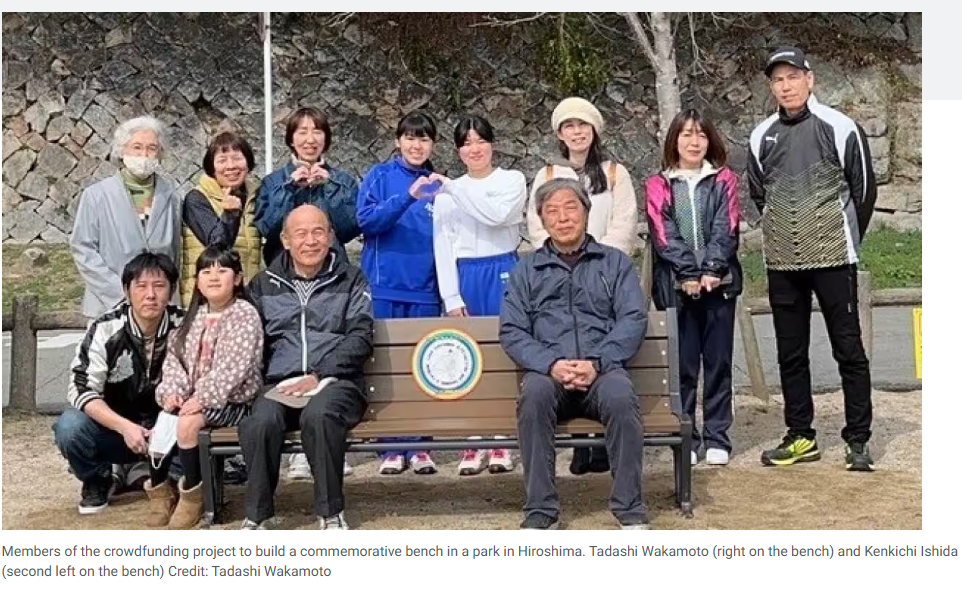
Inspired, the students and their community wanted to make sure this story would not be forgotten. From that vision came the idea of creating a commemorative bench in a local park, where people could sit, reflect, and be reminded that even in the darkest of times, love can grow.
Through a locally-driven crowdfunding campaign, the community rallied together. Launched in mid-December, the campaign closed at the end of January with great success — raising 24,000 yen, exceeding their goal. The funds ensured that Cherry and Gordon’s story would have a lasting place in Hiroshima’s public memory.
On our recent trip to Japan, we were given the special privilege of being invited to tour the area where this story is honoured. We visited the bench — the “seat” that symbolises the enduring love of Cherry and Gordon — and met with several of the teachers and local business leaders who first planted the seed of the idea and then organised the crowdfunding effort. Their passion and commitment to keeping this history alive was deeply moving, a reminder that heritage is strongest when it is carried forward by community.
This project is more than just a bench. It is a symbol of how the next generation is choosing to honour the past: not only remembering hardship and loss, but also cherishing the stories of resilience and connection that grew from those times.
Cherry Parker’s story lives on — not only in the pages of history, but now in the hearts of students, the community of Hiroshima, and the people of Australia.