
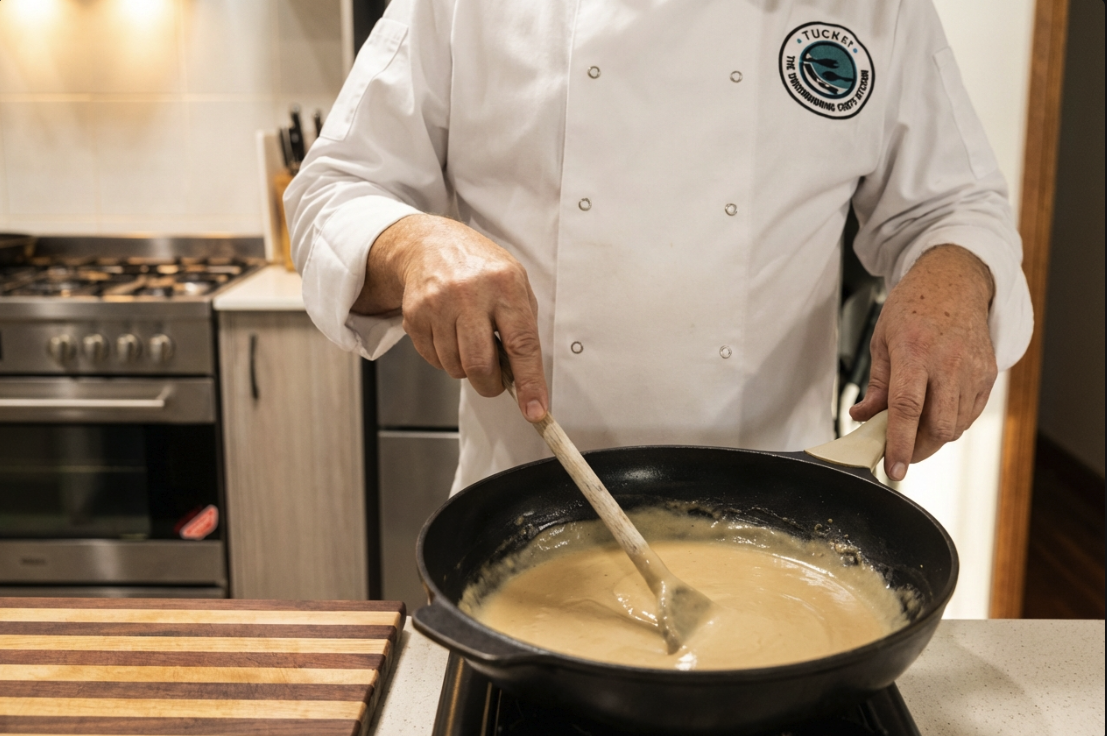
Velouté is one of those quiet chef tricks that instantly lifts a meal. It’s the bridge between “good home cooking” and “how did you make this taste so good?”
Instead of using milk like a béchamel, velouté uses real stock — chicken, fish, or vegetable — which gives you a savoury depth and a cleaner finish. Once you’ve got it, you can turn roast chicken, grilled fish or veg into something seriously polished.
''Once you’ve got velouté sorted, you’ve got a ‘make it fancy’ button for weeknight dinners.''
Chef Ian
I melt butter in a saucepan, then stir in plain flour. I cook it gently for a minute or two — I’m not browning it, just taking out that raw flour taste.
I add stock a little at a time, whisking as I go. Warm stock helps the sauce come together faster and smoother (cold stock can make it claggy).
Once it’s smooth, I let it simmer gently until it reaches a silky, pourable consistency. It should coat the back of a spoon.
I season with salt and white pepper, then strain if I want it ultra-smooth.
Microwave: This is probably the most practical alternative. Melt the butter in a large microwave-safe bowl, whisk in the flour and microwave briefly to cook the roux without colouring it. Gradually whisk in the warm milk, then microwave in approximately 60-second intervals, whisking thoroughly between each, until smooth and thickened. Season at the end.
Thermomix or Heated Food Processor: Appliances that heat and stir simultaneously are particularly well suited to béchamel. They provide constant movement and controlled temperature, reducing the likelihood of scorching or lumps. Use the same core ingredients and follow the appliance’s white sauce/béchamel setting or manufacturer instructions.
Ninja or Multi-Cooker: If the stovetop is unavailable, the Ninja can be used on Sauté mode. Melt the butter, cook the flour into a roux, then progressively whisk in the milk exactly as you would in a saucepan. It is technically the same cooking technique, simply using the appliance pot as the heat source.
The microwave and automated appliances are convenient, but learning béchamel in a saucepan teaches you something they cannot - the ability to see and feel how a roux changes as liquid is added. Once you understand that, making any roux-based sauce becomes much easier.
Roux making, gradual incorporation and flavour control: Velouté uses the same fundamental roux technique as béchamel, but replaces milk with a light stock. This makes the quality and flavour of the stock particularly important.
Master the blonde roux: Melt the butter, add the flour and cook gently while stirring. Unlike the very pale roux used for béchamel, a velouté roux can cook slightly longer until it develops a light blonde colour and subtle nutty aroma. Do not allow it to become deeply browned.
Use a good-quality stock: Chicken, fish or vegetable stock will each create a completely different velouté. Because stock provides most of the flavour, a well-made, balanced stock makes a noticeable difference.
Add the stock gradually: Begin with a small quantity of warm stock and whisk it thoroughly into the roux until smooth. Continue adding the stock progressively, whisking between additions to prevent lumps.
Control the heat: Once the stock has been incorporated, bring the sauce gradually to a gentle simmer. Avoid aggressive boiling, which can reduce the sauce too quickly and make it unnecessarily heavy.
Cook out the flour: Give the finished sauce sufficient gentle cooking time to remove any raw flour taste and allow the flavours of the roux and stock to come together.
Judge the consistency: Velouté should live up to its name - it should be smooth, light and velvety. It should coat the back of a spoon while still flowing easily rather than sitting heavily like a thick gravy.
Adjust with stock: If the sauce becomes too thick, whisk in a little more warm stock. If it is too thin, continue simmering gently until it reaches the required consistency.
Strain for refinement: For an especially smooth finish, pass the completed velouté through a fine sieve before serving.
Season last: Stock may already contain seasoning and can become saltier as it reduces. Taste the finished sauce before adding any additional salt or pepper.
The stock is the personality of a velouté. Chicken stock gives you a versatile savoury sauce, fish stock creates a delicate seafood base, and vegetable stock produces a lighter vegetarian version. Master the roux once, then let the stock determine where the sauce goes next.
Warm stock is your friend: Adding warm stock to the roux helps everything combine smoothly and brings the sauce back to temperature more quickly. Cold stock can work, but you will spend longer getting the sauce back up to heat.
Add the stock progressively: Don’t pour it all in at once. Start with a small amount, whisk until completely smooth, then continue adding more. Get the foundation smooth and the rest becomes easy.
Whisk first, then stir: Use the whisk while incorporating the stock to eliminate lumps. Once the sauce is smooth and beginning to thicken, change to a wooden spoon or spatula and keep it moving—particularly across the base and into the corners of the saucepan.
Don’t walk away: Velouté can go from looking quite thin to properly thickened surprisingly quickly. Once it approaches a simmer, stay with it.
Too thick? Don’t panic: Whisk in a splash of warm stock until the sauce returns to the consistency you want.
Too thin? Give it time: Before reaching for more flour, let the sauce simmer gently for another few minutes. The flour may simply need more heat and time to do its job.
Got a few lumps? It’s not ruined: Give it a vigorous whisk. If that doesn’t completely fix it, pass the sauce through a fine sieve. Nobody at the table needs to know.
Want restaurant-smooth? Strain it: Passing the finished velouté through a fine sieve takes seconds and gives you that beautifully smooth, polished finish.
Season last: Remember that stock already carries flavour and possibly salt. The sauce will also concentrate as it cooks, so taste before reaching for the salt.
Let the sauce tell you when it’s ready: Dip in the back of a spoon and run your finger through the coating. If the line remains clean rather than immediately running back together, you have reached that classic sauce consistency chefs call nappe.
Velouté is very suitable for making ahead and can save considerable time when it will later become the foundation of another sauce or finished dish.
Once cooked, transfer the sauce into a shallow container and cool it promptly. Cover and refrigerate at 5°C or colder and, for best quality, use within approximately 3 days.
If using a particularly delicate fresh fish stock, I would use the velouté sooner - ideally within 1–2 days.
Reheat gently in a saucepan over low-to-medium heat, whisking regularly.
Velouté will thicken as it cools, so add a little warm stock - not water - while reheating until the original silky consistency returns. Using stock maintains the flavour rather than diluting it.
Velouté can also be frozen. Cool completely, portion into airtight containers and freeze for approximately 2–3 months for best quality.
Thaw overnight in the refrigerator, then reheat gently while whisking. If the texture appears slightly separated, a vigorous whisk and a little fresh stock will usually bring it back together.
Making velouté ahead is particularly useful because you are really preparing a sauce foundation. Keep the base relatively neutral, then finish only the quantity you need with cream, wine, mushrooms, herbs or other flavours when you are ready to serve.
Velouté is one of the five classic French mother sauces. Once you can make the basic sauce, changing the stock and adding just a few ingredients opens the door to many different finished sauces.
Suprême Sauce: Start with a chicken velouté and finish with cream for a richer, silky sauce. Traditionally served with chicken and other poultry, but equally lovely with vegetables.
White Wine Sauce: Add reduced white wine to a fish or chicken velouté and finish with a little cream if desired. Particularly good with fish, prawns, chicken and delicate vegetables.
Mushroom Sauce: Sauté sliced mushrooms until golden, then add them to chicken or vegetable velouté. A little cream can be added for extra richness. Excellent with chicken, steak, pork, pasta or vegetables.
Herb Velouté: Finish the sauce with fresh parsley, chives, tarragon or another herb that complements the dish. A simple way to create a fresh sauce for chicken, fish or vegetables.
Lemon Velouté: Add fresh lemon juice and a little finely grated zest at the end of cooking. The acidity cuts through the richness and works particularly well with fish, seafood and chicken.
Seafood Velouté: Make the original velouté with Chef Ian’s fish or prawn stock, then finish according to the dish - with white wine, cream, herbs or a combination. This makes an excellent base for seafood sauces, pies and gratins.
Think about the finished dish before choosing your stock. Chicken stock for poultry, fish or prawn stock for seafood, and vegetable stock for a lighter or vegetarian sauce. Once the base is right, the finishing flavours become the easy part.
That is why learning the mother sauces is so useful: master one technique and you have the foundation for an entire family of sauces.
Béchamel and velouté are both classic French mother sauces and begin in much the same way—with butter and flour cooked together to form a roux.
The key difference is simply the liquid:
Béchamel is creamy, mild and dairy-rich, making it ideal for lasagne, gratins, cheese sauces and pasta bakes.
Velouté takes its flavour from the stock used - chicken, fish or vegetable - making it more savoury and versatile for poultry, seafood, vegetables and finished sauces such as Suprême, mushroom or white wine sauce.
Master the roux and you are already halfway to making both. Change the liquid and you change the sauce - that is the beauty of learning the foundations.
Yes. Replace the plain flour with a suitable gluten-free flour blend. Chef Ian has also used Lupins for Life Lupin Flour as an alternative.
Different gluten-free flours may have slightly different thickening strengths, so add the stock gradually and judge the finished sauce by its consistency.
Note: Lupin is a recognised food allergen and will not be suitable for everyone.
Yes. Although velouté contains no milk, the traditional roux is made with butter. Replace the butter with olive oil or a suitable dairy-free spread and continue with your chosen stock.
Check that the stock itself contains no dairy ingredients if cooking for someone with a dairy allergy or intolerance.
Absolutely. Use a good vegetable stock and replace the butter with olive oil or a plant-based alternative for a completely plant-based velouté.
That gives you the same structure as béchamel, but appropriately adapted for what is actually in this sauce.
Makes approximately 500–550 ml