
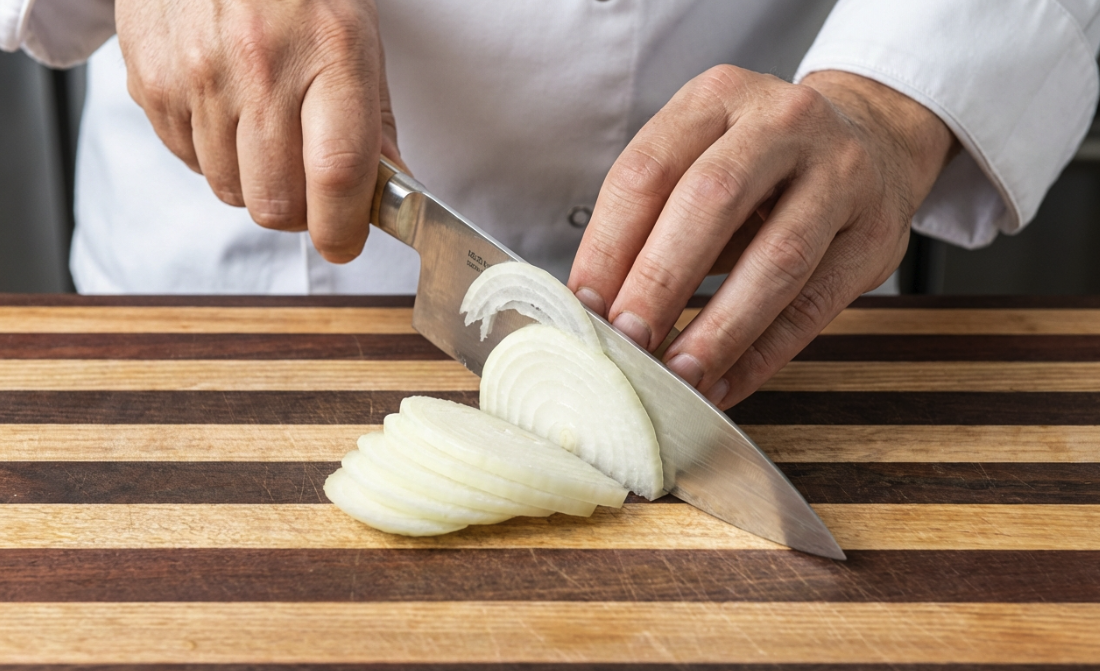
Every great dish starts with the right cut — and the humble onion is where it all begins.
In this quick guide, I’m showing you the main onion cuts I use every week and (more importantly) when I use each one, so your prep makes sense and your food cooks the way you want.
And before we even start… here’s the golden rule:
Sharp knife first. Always.
A blunt knife is more dangerous (because it slips), and it also crushes the onion as it cuts — which is exactly what brings the tears on faster. Let’s not do that.
“A sharp knife and a steady hand — that’s all you need to turn a simple onion into the start of something special.”
Chef Ian
Chef Ian demonstrates the traditional knife techniques, but there are several kitchen tools that can make preparing onions quicker and more manageable—particularly for anyone with limited hand strength, mobility or dexterity.
A mandoline produces thin, even onion slices and is useful for salads, pickles, caramelised onions and garnishes. Always use the supplied safety guard or a cut-resistant glove, keep your fingers well away from the blade and place the mandoline on a stable surface.
A food processor fitted with a slicing blade can prepare a larger quantity of evenly sliced onion very quickly. The standard chopping blade can also be used for diced or finely chopped onion, but work in short pulses to avoid turning it into a wet purée.
A push-down or pull-cord chopper can be an excellent option for anyone who finds repeated knife movements difficult. Cut the onion into a few manageable pieces first, then use the chopper to achieve the required size.
A grid-style vegetable dicer produces fairly even cubes with one downward action. Choose a sturdy model with a non-slip base, and avoid forcing particularly large or firm pieces through the cutting grid.
These comb-like tools hold the onion in place while guiding the knife between evenly spaced prongs. They can provide added stability and keep the guiding hand farther away from the blade.
There is no shame in using a kitchen tool that makes preparation safer or more comfortable. A good cook chooses the method that suits their ability, the quantity being prepared and the result they want. Whatever tool you use, make sure it is sharp, stable and used with the appropriate safety guard.
A sharp knife is a safer knife: It may sound contradictory, but a blunt knife is more likely to cause an accident. It requires greater pressure to cut through the onion and can slip sideways rather than travelling cleanly through it. A sharp knife gives you greater control and lets the blade do the work.
Create a stable base: Never try to cut a whole, round onion while it is rolling around the board. Cut it in half through the root first, then place the flat side firmly against the board before continuing.
Keep the root attached: The root helps hold the onion’s layers together while you slice or dice it. It gives you a more stable piece of food to work with and keeps your fingers farther away from the blade. Remove the root only after you have completed your cuts.
Use the claw grip: Curl the fingertips of your guiding hand underneath and allow your knuckles to face the blade. The side of the knife can then rest lightly against your knuckles as a guide while your fingertips remain safely tucked away.
Use a secure chopping board: Place a damp cloth, paper towel or non-slip mat underneath your board to prevent it from sliding. A moving board can be every bit as dangerous as an unstable onion.
Don’t force the knife: If the blade will not pass easily through the onion, stop and check it. Forcing a blunt or unsuitable knife increases the chance that it will twist or slip.
Slow down before you speed up: Good knife skills begin with accuracy and control - not speed. Establish a comfortable rhythm and keep each cut consistent. Speed will develop naturally with confidence and practice.
Keep your eyes on the blade: Finish cutting before turning to speak, reaching for another ingredient or looking at the stove. Most small kitchen accidents happen during a moment of distraction.
Carry a knife correctly: If you need to move with a knife, hold it securely by the handle with the blade pointing down and close to your side. Never leave a knife hidden under onion peel, in a sink full of water or near the edge of the bench.
Your knife should feel like an extension of your hand—not something you need to fight. Keep it sharp, stabilise your ingredients and concentrate on control rather than speed. Once the safe habits become automatic, your cutting will naturally become quicker and more consistent.
Onions can be prepared ahead of time, making it easier to get dinner started when time is short.
Once sliced or diced, place the onion in an airtight container and refrigerate. For the best flavour and texture, use it within 2–3 days. Keeping the container properly sealed will also prevent the onion’s strong aroma from spreading through the refrigerator.
If you only use half an onion, leave the skin and root attached to the unused portion where possible. Wrap it securely or place it in a sealed container, refrigerate and use within the next few days.
Chopped onion can also be frozen. Divide it into recipe-sized portions and store it in airtight freezer bags or containers for up to three months. Frozen onion will soften once thawed, so it is best used in cooked dishes such as soups, curries, casseroles, sauces and stir-fries rather than salads or fresh garnishes.
There is no need to thaw frozen onion before cooking - simply add it directly to the pan. It may release a little extra moisture, so allow this to evaporate before adding the remaining ingredients.
If you regularly have small amounts of onion left over, keep a labelled freezer container specifically for vegetable offcuts. Onion ends and usable trimmings can later be added to homemade stocks, helping reduce waste and make the most of every ingredient.
Best for: sauces (hello Diane), bruschetta, soup bases, flavouring mince, anything where you want the onion to “melt in”.
Why it works: smaller pieces cook quicker and disappear into the dish, giving you flavour without big chunks.
Best for: casseroles, curries, tray bakes, slow cooks.
Why it works: bigger pieces hold their shape longer and give you that proper homestyle bite.
Best for:
Why it works: slicing controls how the onion softens, browns, and holds together.
Onions - can be either white, brown or salad varieties