
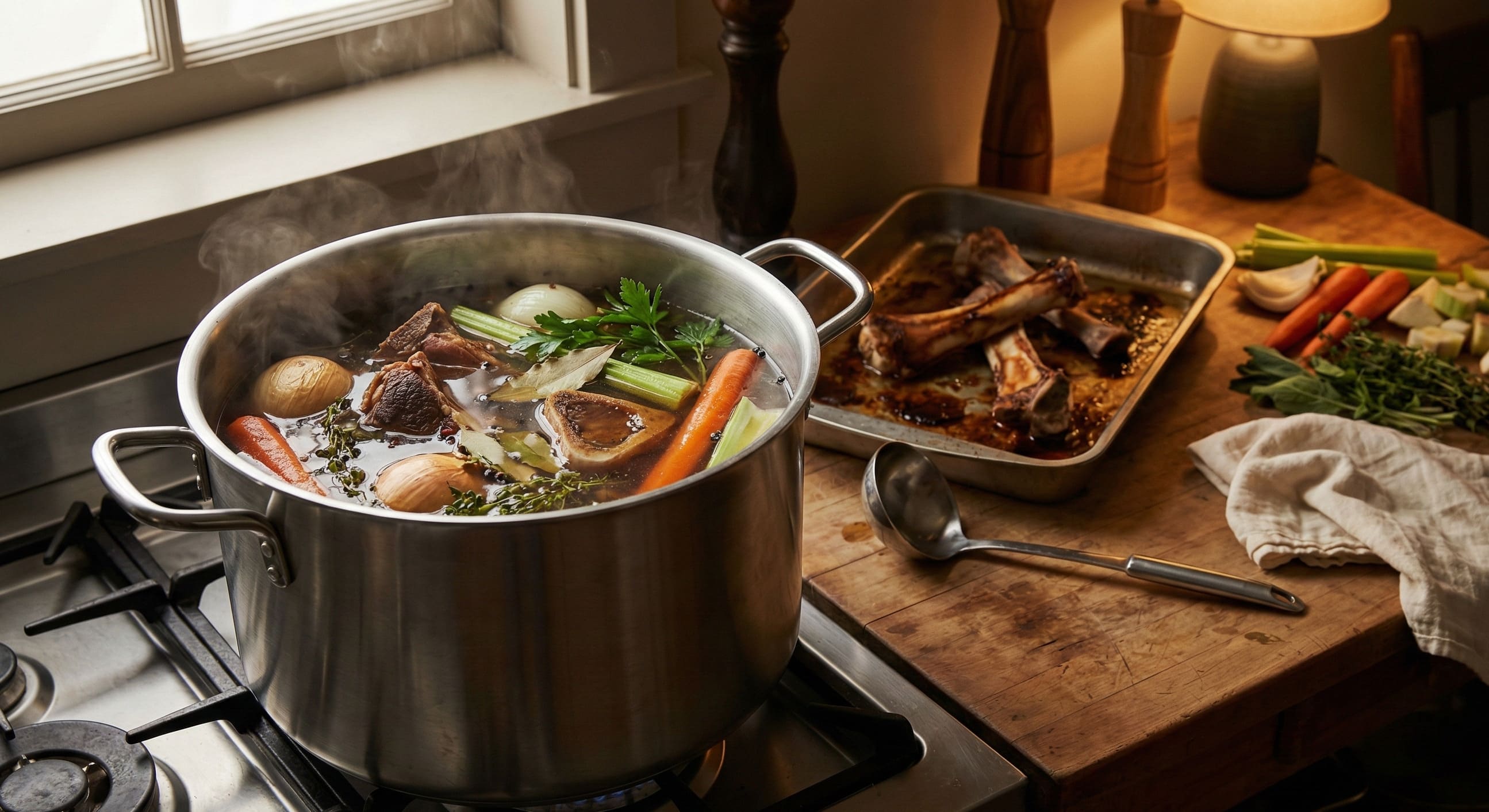
Beef stock is all about patience and depth — that slow, satisfying process where every layer builds on the next.
This is the stock that sits behind glossy sauces, braises, gravies, and proper comfort food. And once you’ve got it in the freezer, you’ve basically got a flavour shortcut for future-you.
"Roast the bones properly and the stock does the rest — that’s where real depth comes from."
Chef Ian
The Ninja’s two-hour pressure-cooking stage provides the prolonged, high-temperature extraction that beef bones need while containing the process in one appliance. The stovetop version requires considerably longer because it works at a lower temperature.
Follow Ian’s same roasting stage in a conventional oven:
Brown beef stock needs deep caramelisation, not burnt bones. Rich brown edges create flavour and colour; blackened areas create bitterness. Once the water is added, keep the stock at a gentle simme - rapid boiling can emulsify fat and impurities into the liquid and make it cloudy and greasy.
Caramelisation, bone selection and prolonged extraction: A rich brown beef stock depends on building flavour before the water is added, then giving the bones sufficient time to release their collagen and savoury depth.
Choose a mixture of bones: Marrow bones provide richness, knuckle and joint bones contribute collagen and body, and meaty bones develop the beef flavour. Using a combination creates a better-balanced stock than relying on one type alone.
Roast for colour and flavour: Roasting the bones and vegetables at 190°C creates caramelisation through the Maillard reaction. This provides the deep colour and roasted flavour that distinguish brown beef stock from white beef stock.
Brown—do not burn: Turn the bones and vegetables during roasting so they colour evenly. Deep golden-brown edges are desirable; blackened bones or vegetables will introduce bitterness that cannot be removed later.
Cut the vegetables roughly: Large, fairly even pieces are suitable because they must withstand the long cooking time. Finely chopped vegetables may break down and make the finished stock cloudy.
Start with cold water: Adding cold water allows the temperature to rise gradually and encourages a controlled extraction of flavour, protein and collagen from the bones.
Use the correct water ratio: The water should cover the bones without unnecessarily diluting the stock. When pressure cooking, the total contents must always remain below the appliance’s maximum-fill line.
Allow sufficient extraction time: Beef bones are dense and require much longer than fish or vegetable ingredients to surrender their flavour and collagen. Ian’s two-hour high-pressure method provides the extended extraction needed for a full-bodied stock.
Use a natural pressure release: Allowing the pressure to reduce naturally keeps the liquid settled and reduces the risk of hot, fatty stock being forced through the pressure valve.
Strain without pressing: Pass the stock through a fine sieve and allow it to drain naturally. Pressing or crushing the vegetables and bones may force fine particles into the liquid and make it cloudy.
Chill before removing the fat: Once refrigerated, the beef fat will rise and set on the surface, making it easy to lift away. The stock underneath may set like jelly due to its natural collagen—this is a sign of a well-made stock.
Leave the salt until later: Beef stock is often reduced substantially when making sauces and jus. Keeping it unsalted gives you complete control over the final seasoning.
The depth of a brown beef stock is created during roasting, while its body develops during pressure cooking. Give equal attention to both stages: build deep colour without burning, then allow enough time for the bones to release their flavour and collagen. Good stock cannot be rushed—but it can certainly be made easier with the right equipment.
Beef stock is an excellent make-ahead ingredient. Preparing it a day before it is needed allows the fat to set firmly on the surface, making it much easier to remove and leaving a cleaner stock underneath.
Once cooked, strain the stock and discard the bones, vegetables and aromatics.
Divide the stock between several shallow containers or place the pot into an iced-water bath. Stir occasionally to release the heat, taking care not to allow water from the ice bath to enter the stock.
Do not leave a large, deep pot of stock sitting on the bench to cool slowly. Refrigerate it promptly once the initial heat has reduced.
Cover and refrigerate the cooled beef stock for up to 3–4 days.
As it chills, the fat will rise and form a firm layer on the surface. Lift this away before using the stock. A small quantity can be retained and used for roasting vegetables or potatoes, if desired.
A collagen-rich stock may set like jelly in the refrigerator. This is a positive sign and means the bones have released plenty of natural gelatin. It will return to liquid once heated.
Freeze the stock in quantities suited to your cooking:
Leave room at the top of rigid containers because the stock will expand as it freezes. Label each portion with the type of stock, quantity and date. For the best flavour and quality, use within approximately three months.
If freezer space is limited, gently reduce the strained stock to concentrate it before freezing. Pour it into small containers or ice-cube trays, then dilute it with water when required.
Because the stock is concentrated, keep it unsalted and label it clearly as reduced beef stock.
Thaw overnight in the refrigerator, reheat gently from frozen in a saucepan or add a frozen portion directly to the dish. Bring it rapidly to a thorough simmer before using.
Make beef stock the day before you need it. Chilling overnight allows the fat to separate cleanly and gives you a clearer, better-balanced result. Portioning the finished stock before freezing also means you can use exactly what each recipe requires without wasting the remainder.
Unlike brown beef stock, a white beef stock is made without roasting or colouring the bones and vegetables. This produces a paler, more delicate stock that supports a dish without adding the deep roasted flavour or dark colour of traditional brown beef stock.
To prepare it:
White beef stock is useful for lighter soups, pale sauces, gentle braises and dishes where a deeply roasted flavour or dark colour would be overpowering.
“White” does not mean that the stock will be colourless. It simply means the bones and vegetables have not been roasted. The careful blanching, rinsing and skimming stages are what help produce a cleaner, paler finished stock.
Use a mixture of bones: Marrow bones contribute richness, knuckle and joint bones provide collagen and body, and meaty bones add beef flavour. Using only marrow bones can result in a stock that is fatty but lacks balance.
Keep the aromatics restrained: Thyme, bay leaf, parsley stalks and peppercorns support the beef without dominating it. Strong herbs such as rosemary can easily overpower a stock during the long pressure-cooking time.
Do not add salt: The stock may later be reduced for a sauce or jus, which would concentrate any salt already present.
No salt is required—the stock can be seasoned when it is used in the finished dish.