Your no-stress guide to ordering, serving, and cooking smallgoods with confidence.
I’ll be honest… growing up in the 60s, “smallgoods” in our house meant two things: Strasburg and Spam. That was the deli selection. No prosciutto, no sopressa, no bresaola… and definitely no one arguing about the correct way to pronounce capocollo.
Fast-forward to today and look at us — we’ve got delis packed with cured meats from all over the world. And that’s one of the great gifts of multicultural Australia: we’re spoiled for choice, and our kitchens are better for it.
But here’s the thing… that deli cabinet can still feel intimidating. So this guide is here to make it simple:
what it is, how it tastes, how you use it, and how to order it confidently — without feeling like you need a dictionary.
Ever walked into a delicatessen, taken one look at the cabinet display, and quietly panicked?
Rows of cured meats, smoked sausages, and unfamiliar names — prosciutto, sopressa, pancetta, coppa, speck, pastrami — and somehow you walk out with the same old sliced pepperoni… again.
You’re not alone.
Smallgoods are one of the most flavour-packed corners of the food world — and once you understand the basics, you’ll start using them for more than just sandwiches:
If you remember nothing else, remember this — most smallgoods sit in one of these lanes:
Air-dried or salt-cured. Usually sliced thin and served at room temp.
Examples: prosciutto, bresaola, coppa, speck (sometimes), salami
Fully cooked already. Great in sandwiches and platters.
Examples: mortadella, strasburg, ham, devon, bologna
Sausages and some specialty meats that shine when heated.
Examples: kransky, bratwurst, knackwurst, lap cheong
Small amounts, huge impact — used to build flavour in dishes.
Examples: pancetta, chorizo, bacon, smoked ham hock
Below are the most common ones you’ll actually see — what they taste like and how to use them.
Salami – savoury, lightly tangy, often garlic/fennel/pepper.
Best for: platters, sandwiches, pizza, pasta.
Prosciutto – sweet-salty, delicate, melts on the tongue.
Best for: served raw with melon/figs/bread.
Chef tip: don’t cook premium prosciutto — room temp is the move.
Pancetta – salt-cured pork belly, rolled or flat.
Best for: sauce bases, risotto, soups.
Chef tip: render it slowly — flavour foundation in minutes.
Coppa / Capocollo – air-dried pork neck/shoulder, marbled and fragrant.
Best for: boards, focaccia, pizza, cheese pairings.
Mortadella – silky, mild, delicate spice, visible fat cubes.
Best for: sliced cold, toasties, grazing.
Chef tip: good mortadella is soft and aromatic, never rubbery.
Bresaola – lean cured beef, clean and lightly salty.
Best for: lighter boards, salads, lemon/rocket/parmesan vibes.
Chorizo – smoky paprika, bold, rich.
Best for: tapas, paella, roasted veg, pasta.
Chef tip: warm it first to release oils.
Pastirma / Basterma – cured beef coated in spiced paste (fenugreek/garlic/paprika).
Best for: thin slices with bread, eggs, or a bold board.
Kransky – smoky, garlicky, chunky bite.
Best for: grilled/pan-fried, sliced and served hot.
Bratwurst – mild, juicy pork/veal sausage.
Best for: grill or fry, mustard on the side.
Chef tip: poach first, brown second = juicy.
Knackwurst – juicy, garlicky, the “snap” sausage.
Best for: gentle simmer or grill — the snap is the point.
Brawn (Head Cheese) – terrine-style cold cut set in jelly.
Best for: sliced cold with mustard/pickles.
Cabanossi / Kabana – firm, lightly smoked, garlicky.
Best for: workhorse platter item — holds shape, travels well.
Ham – sweet-savoury comfort, many styles.
Best for: sandwiches, omelettes, platters.
Bacon – smoky, salty, crisp when cooked right.
Chef tip: slow cook to render fat evenly.
Devon / Polony – mild, nostalgic.
Best for: sandwiches, or crumbed and fried if you’re feeling cheeky.
Strasburg – finely textured, mild, lightly smoked.
Best for: family-friendly platters and sandwiches.
Chef tip: think of it as the Aussie cousin of mortadella.
Spam – yep, it deserves a mention.
Pan-fried Spam in a sandwich with pickle? It’s strangely good — and it’s a reminder of how far our food culture has come.
Lap Cheong – sweet-savoury Chinese sausage, rich when cooked.
Best for: sliced and pan-fried, rice dishes, stir-fries.
Chef tip: a little goes a long way.
You don’t need perfect pronunciation. You just need a plan.
Try one of these:
Start small:
That’s not beginner behaviour — that’s how smart cooks discover new favourites.
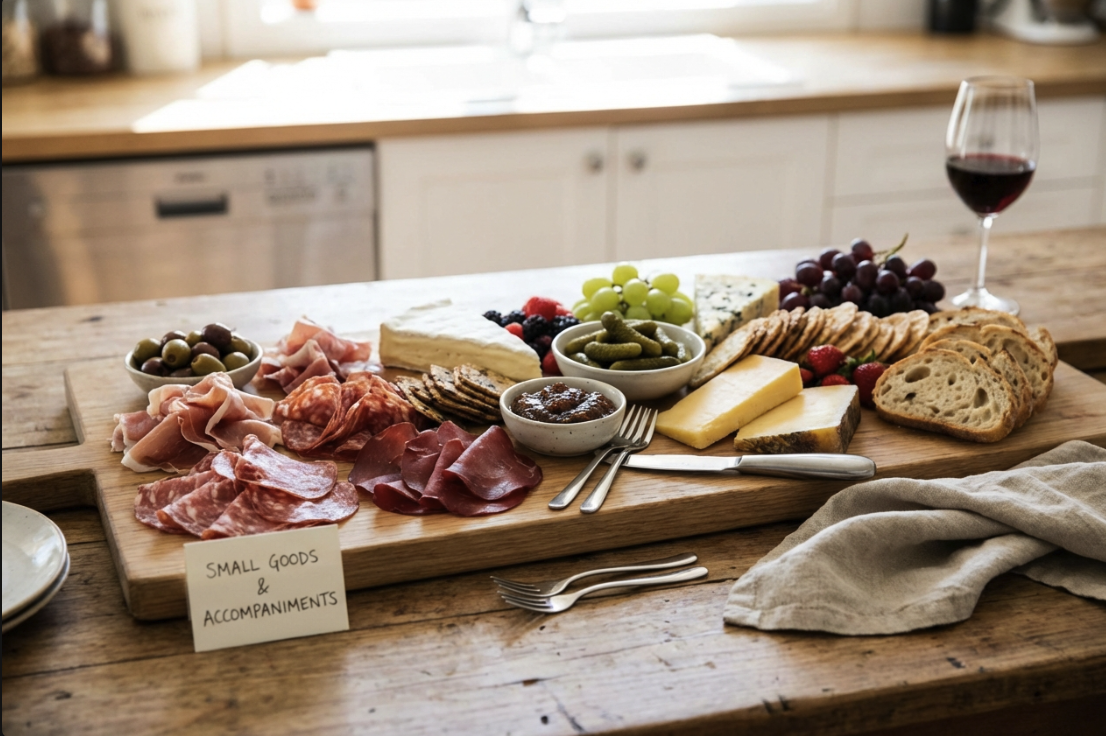
Forget perfection. A great board is about contrast.
Cold • Cooked • Bold • Mild
Pick 4–6 items across these roles:
Cold & Delicate: prosciutto, bresaola, mortadella
Cooked & Comforting: kransky, bratwurst, lap cheong (cooked)
Bold & Flavour-Forward: chorizo, sopressa, pastrami
Mild & Crowd-Pleasing: strasburg, ham, devon, bologna
A perfect first “confident board”:
Prosciutto + mortadella + cabanossi + kransky (hot)
Balanced, interesting, zero stress.
If there’s one thing I hope you take from this guide, it’s this:
You don’t need to know everything to cook — or entertain — well.
Confidence comes from curiosity. From asking for a taste. From trying one new thing at a time. And thanks to the world of flavours we’ve got right here in Australia now… we’re honestly pretty lucky.
Next time you’re at the deli, step one inch past the familiar.
That’s where the fun starts.
Che Ian