
By Chef Ian — Underground Chef
Ever wondered why some meals just work — that perfect harmony where every bite feels right?
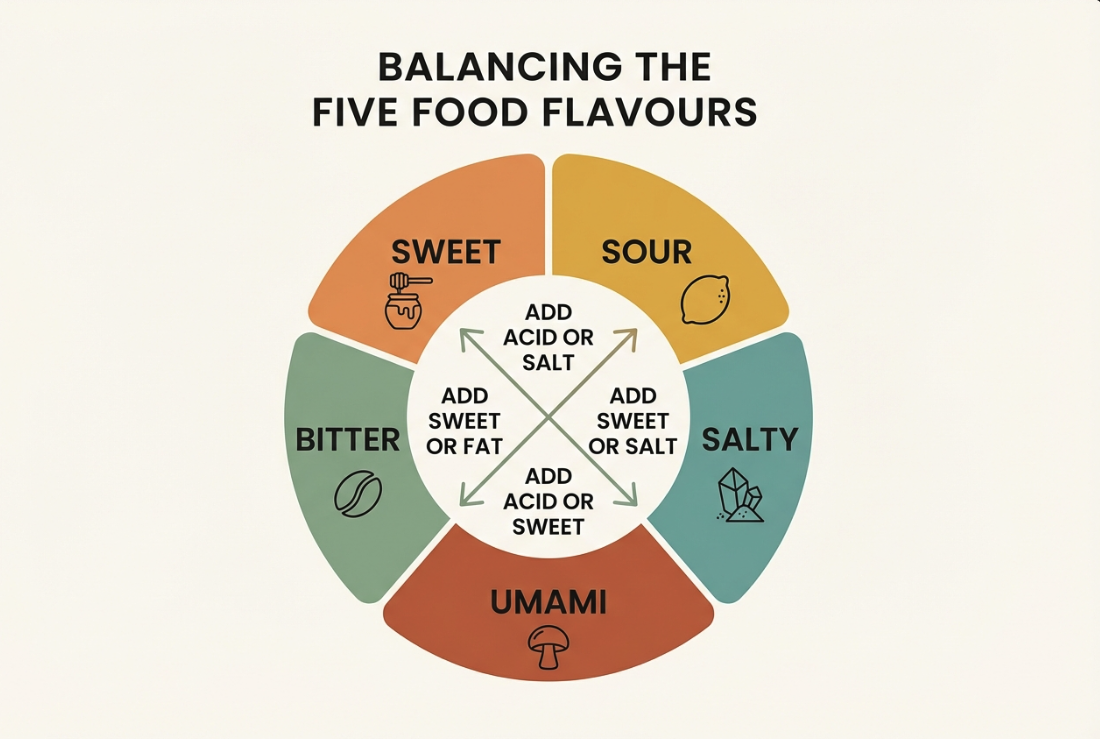
Chefs don’t just follow recipes — they think in flavour. And nearly every dish comes back to five key tastes:
Sweet • Sour • Salty • Bitter • Umami
Master these and you won’t just cook more confidently — you’ll know exactly what to do when something tastes flat, too sharp, too heavy, too sweet… you name it.
What I’m always chasing is what I call full-mouth flavour — not one taste dominating, but all five working together.
What it does: Sweetness softens acidity, rounds spice, and brings comfort and depth.
Everyday examples: roasted pumpkin, caramelised onion, honey, sweet corn.
Underground Chef favourites:
Use it when: A dish feels too sharp, spicy, or acidic.
Chef trick: A tiny touch is enough — try honey in a vinaigrette, or a spoon of caramelised onion in tomato-based sauces.
What it does: Acid brightens food, cuts through richness, and wakes up “flat” flavours.
Everyday examples: lemon, lime, vinegar, yoghurt, pickles.
Underground Chef favourites:
Use it when: A dish feels heavy, rich, or bland.
Chef trick: I add dill pickles to beef stroganoff — that tang slices straight through the creamy richness.
Also worth knowing: Japanese pickles (tsukemono) with Curry Rice aren’t just a garnish — they cleanse the palate and add that bright contrast.
What it does: Salt amplifies everything — sweetness, savouriness, even bitterness. It’s flavour’s volume knob.
Everyday examples: salt, butter, preserved meats, feta, parmesan.
Underground Chef favourites:
And don’t think “salt” only means salt:
soy, anchovies, dashi, miso — all bring saltiness plus built-in depth.
(Hello Ortiz Anchovies, GOZEN Dashi Powder, GOZEN Green Pea Miso / 16 Grain Miso.)
Use it when: Food tastes dull or incomplete.
Chef trick: Season in layers — a pinch during cooking, then taste and adjust at the end.
What it does: Bitter adds contrast and complexity. It stops food feeling one-note, overly sweet, or too rich.
Everyday examples: rocket, kale, coffee, dark chocolate, char.
Underground Chef favourites:
Use it when: A dish feels too sweet or too rich.
Chef trick: Don’t fear the char. A little caramelisation/blackened edge on veg adds a beautiful, controlled bitterness. Even a pinch of unsweetened cocoa in a beef chilli can add depth without making it sweet.
What it does: Umami is the savoury “soul” — rich, meaty, deeply satisfying, and seriously moreish.
Everyday examples: mushrooms, parmesan, tomato, soy, miso, stock.
Underground Chef favourites:
Use it when: A dish tastes flat or one-dimensional.
Chef trick: Layer umami. Start with a base (stock/dashi), build with miso/soy, finish with something aged/fermented/roasted.
When one flavour takes over, another brings it back into line:
Cooking becomes instinctive when you start tasting through the lens of flavour — not just ingredients.
Because every great meal is a little dance between these five… and when you get them in step, that’s when the magic happens.
“If a dish ever tastes ‘not quite right’, don’t start over - just balance it. A pinch of salt, a squeeze of citrus, a touch of sweetness, a little char, or a hit of umami… small moves make big magic. Taste as you go, and chase that full-mouth flavour.”
Chef Ian