
G’day — Chef Ian here.
After nearly five decades in kitchens across Australia, here’s what I know for sure: great cooking isn’t about memorising recipes — it’s about understanding heat. Once you know what heat is doing to your food, you can cook almost anything with confidence.
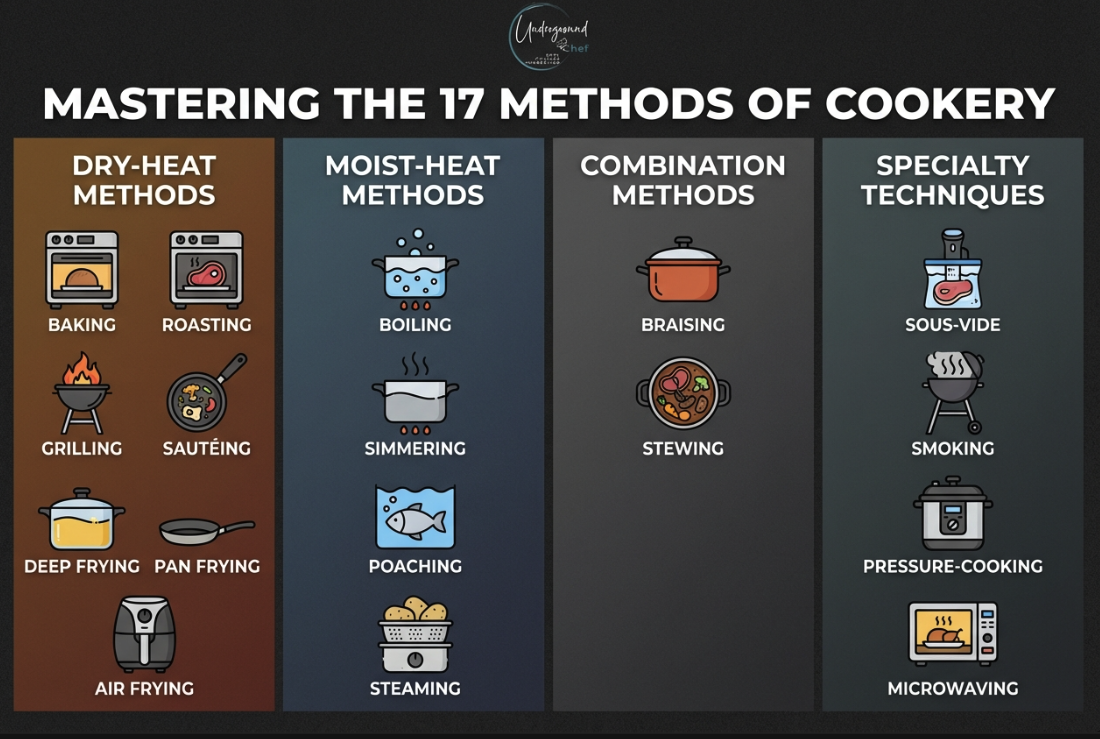
So think of this as your kitchen map. When you know the method, you’ll know the move.
These are your “golden edges, crispy bits, and big flavour” techniques.
What it is: Cooking with hot air in an oven (or air fryer).
Best for: breads, cakes, slices, pies, bakes.
Do this:
Common stuff-up: opening the oven every 5 minutes = temperature drops = longer cook time.
Chef tip: If eggs/milk are in the recipe, room temp helps texture and rise.
What it is: Dry heat + a bit of fat to drive browning and flavour.
Best for: meats + veg (your Sunday hero).
Do this:
Chef tip: Want crackling? Dry the pork skin overnight in the fridge, start hot, then reduce.
What it is: Direct high heat — fast, bold flavour.
Best for: steaks, chicken, seafood, veg.
Do this:
Chef tip: Finish with a squeeze of lemon or a knob of butter — fat + acid = balance.
What it is: Quick cooking in a small amount of fat over medium-high heat.
Best for: stir-fries, sliced meats, seafood, veg.
Do this:
Chef tip: Splash in stock/wine/citrus at the end to deglaze — instant sauce from the good bits.
What it is: Shallow oil for a golden, crisp finish.
Best for: schnitzel, fish, fritters, rissoles.
Do this:
Chef tip: If it’s greasy, oil was too cool. If it’s burnt outside/raw inside, oil was too hot.
What it is: Full oil submersion for even crunch.
Best for: chips, doughnuts, tempura, crispy chicken.
Do this:
Chef tip: Season as soon as it comes out — salt sticks best while hot.
What it is: Rapid hot air for “fried-style” crunch with minimal oil.
Best for: chips, wings, schnitzel, fish, roast veg, reheats.
Do this:
Chef tip: A light spritz of oil near the end boosts colour and crunch without greasiness.
Gentle cooking in liquid or steam — great for tenderness, clarity, and clean flavour.
What it is: Vigorous bubbling liquid (around 100°C).
Best for: pasta, potatoes, eggs, some veg.
Do this:
Chef tip: Don’t boil veg to death — that’s how you get grey, sad sides.
What it is: Gentle bubbles, 85–95°C.
Best for: soups, curries, sauces, stocks.
Do this:
Chef tip: Simmering is the kitchen’s “slow groove” — steady heat = better texture.
What it is: Low-temp liquid cooking, 70–80°C (no bubbling).
Best for: fish, chicken breast, eggs, fruit.
Do this:
Chef tip: Poached chicken makes killer salads and sandwiches — moist, never stringy.
What it is: Cooking with steam (clean, bright, nutrient-friendly).
Best for: veg, dumplings, seafood.
Do this:
Chef tip: Line the steamer with baking paper or cabbage leaves to stop sticking.
Dry heat first for flavour, then moisture for tenderness.
What it is: Brown first, then slow cook in a small amount of liquid.
Best for: lamb shanks, beef cheeks, marylands, root veg.
Do this:
Chef tip: Braising is how you turn “tough cuts” into “wow cuts”.
What it is: Like braising, but fully submerged in liquid.
Best for: curries, casseroles, stroganoff, chunky veg stews.
Do this:
Chef tip: Stew tastes better tomorrow — flavours settle overnight.
Modern tools and precision methods that make consistency easier.
What it is: Vacuum-sealed food cooked in a controlled water bath.
Best for: steaks, chicken, fish, eggs.
Do this:
Chef tip: Sous-vide isn’t “fancy” — it’s stress-free doneness. Perfect when you don’t want to overcook.
What it is: Low heat + smoke for aroma and tenderness.
Best for: brisket, ribs, chicken, salmon, even veg.
Do this:
Chef tip: Too much smoke turns bitter. A “kiss” is better than a “punch”.
What it is: High-pressure cooking for speed + tenderness.
Best for: stocks, soups, stews, tougher cuts.
Do this:
Chef tip: Modern pressure cookers are safe and brilliant — no drama, just results.
What it is: A tool for reheating and quick jobs (not a cheat).
Best for: reheats, steaming small veg, melting, softening.
Do this:
Chef tip: Reheating dense foods (rice, pasta, lasagne)? Add a tiny splash of water and cover — keeps moisture.
Whether you’re roasting a Sunday chook, simmering a stock, or reheating leftovers properly, it all comes back to one thing: how heat transforms food.
Cooking has always been about connection for me — the sizzle of a pan, the smell of a roast, and the smile when someone takes that first bite. If this guide helps you find more of that joy (and confidence) at home, then I’ve done my job.
So keep practising, keep tasting — and don’t be afraid to make a bit of a mess. That’s how great food (and great memories) are made.
Chef Ian