
By Chef Ian – Underground Chef
There’s a myth in home kitchens that a sharp knife is a dangerous knife.
Let’s put that to bed right now.
A dull knife is far more dangerous than a sharp one. Why? Because when a knife loses its edge, it stops cutting properly and starts forcing you to do the work. That means more pressure, more pushing, less control, and a much greater chance of the knife slipping where you don’t want it to.
A sharp knife, on the other hand, does what it’s supposed to do — it cuts cleanly, easily, and with control.
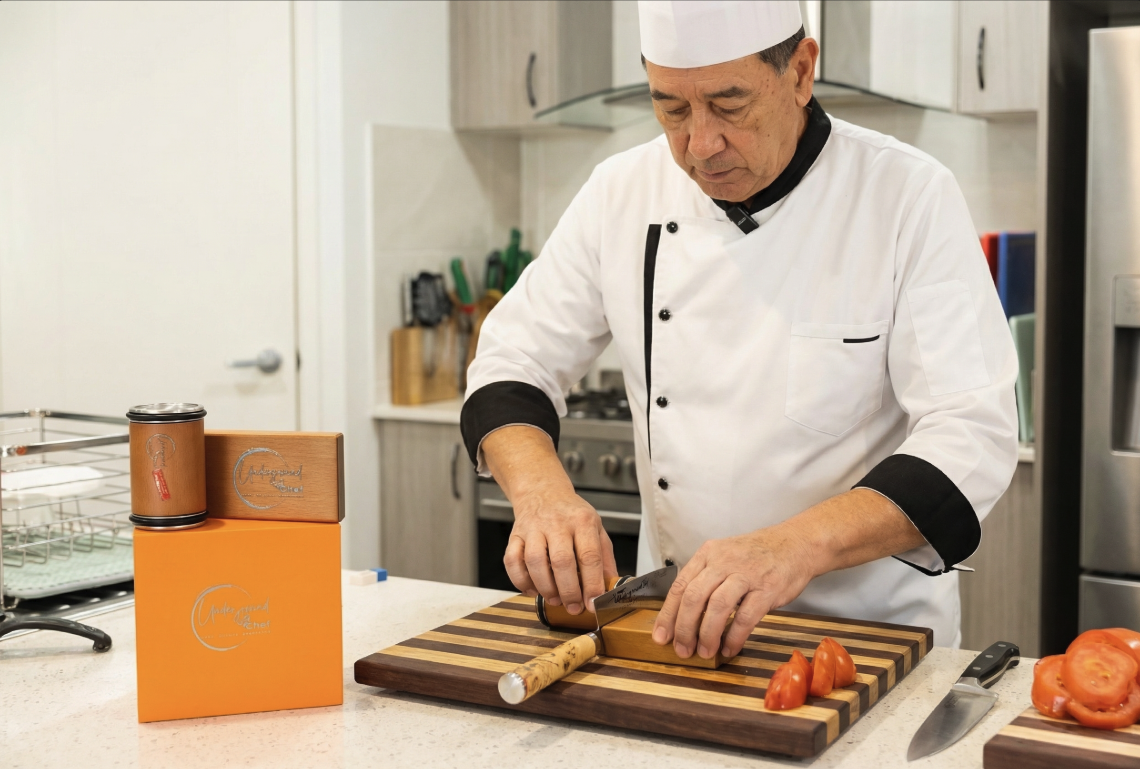
And that’s exactly what Chef Ian demonstrates in this tutorial.
One of the easiest ways to show the difference between a sharp knife and a dull one is with a tomato.
Take a dull knife to a tomato and you’ll usually find yourself pressing down harder, sawing back and forth, squashing the flesh, tearing the skin, and ending up with a messy, damaged piece of fruit instead of a neat slice.
Now take a sharp knife.
With very little pressure, the blade glides straight through the skin and into the flesh, giving you a clean, precise cut without crushing the tomato. No struggle. No mess. No mangled slices.
That’s the difference.
It’s not just about presentation either — it’s about safety, control, and making prep work easier and more enjoyable.
When your knife is blunt, a few things start happening:
In other words, the knife stops being a tool and starts becoming a liability.
A good knife should feel like an extension of your hand — not something you have to wrestle with.
There are a few different ways people sharpen knives, and some methods are better suited to experienced users than everyday home cooks.
These can absolutely produce an excellent edge in the right hands.
But they do require skill, consistency, and a good understanding of angle, pressure, and technique. If you don’t know what you’re doing, it’s very easy to damage the blade, remove too much metal, or create an uneven edge.
That’s not a great outcome — especially if you’ve invested in a quality knife.
So for many home cooks, Chef Ian’s advice is simple: if you’re not trained or confident with stones, put that option aside.
These are popular because they seem easy.
Pull the knife through a few times, then move to the next slot to “finish” the edge. Sounds convenient — but here’s the problem.
Many pull-through sharpeners are quite aggressive and can remove a lot of metal from the blade. Over time, that can leave visible gouges and wear down the knife much faster than it should. Chef Ian even shows a knife with a definite groove worn into it from repeated use of this style of sharpener.
That’s not sharpening with care — that’s chewing away at the value of your knife.
So again, let’s put that option aside too.
Professional sharpening is another option, and we’ve all seen the shopping centre booths offering that service. But it does come at a cost. I was recently quoted around $20–$25 per knife, and if you’re doing that several times a year, it soon becomes expensive. You’re also trusting a valuable knife to someone you don’t know, hoping they have the skill to sharpen it properly without damaging the blade. So while professional sharpening can work, it’s not always the most economical — or least risky — option for the everyday home cook.
This is one of the biggest misunderstandings in the kitchen.
A steel does not sharpen a blunt knife.
What it does is hone the edge.
When you use a knife regularly, the very fine edge can start to roll slightly or develop a tiny burr. A steel helps straighten that edge and tidy it up, which can make the knife feel better again for a while.
That’s useful. Very useful.
But if the knife is actually blunt, a steel won’t bring back a proper sharp edge. It’s maintenance, not miracle work.
So if your knife is already dull, steeling it won’t solve the problem. It needs sharpening first.
So what if you want something that is:
That’s where the Chef Tested Rolling Knife Sharpener comes in.
Chef Ian demonstrates this as a simple, practical option for people who want to keep their knives in good condition without the risk and complexity of other methods.
The system is straightforward.
For Asian-style knives, use the 15-degree angle.
For European-style knives, use the 20-degree angle.
You attach the knife to the magnetic angle guide, then use the rolling sharpener along the blade.
Start with the coarse side of the roller and gently roll it up and down along one side of the knife. Then flip the knife and repeat on the other side.
After that, switch to the other end of the roller — the honing side — and repeat the process. This step acts much like a steel, refining and tidying the edge after sharpening.
Then simply wipe the blade clean and your knife is ready to use.
That depends on two things:
Chef Ian’s advice is simple: don’t wait until your knife is completely blunt.
It’s far better to maintain the edge regularly than to let it deteriorate and then try to rescue it later. For many home cooks, a light sharpen around once a week can be enough, depending on use.
Think of it like this — maintaining a knife is easier than restoring one.
Another great feature is how easy it is to clean.
Over time, tiny metal fragments can build up on the diamond discs. To remove them, simply rub the disc gently with an eraser. The metal particles lift off easily, leaving the surface clean and ready for the next use.
Simple. Effective. No fuss.
A sharp knife is not something to fear.
A sharp knife is something to respect.
It gives you better control, cleaner cuts, less waste, less damage to ingredients, and a safer, more enjoyable cooking experience. A dull knife does the exact opposite.
If you want to cook with confidence, your knives need to be working with you — not against you.
And if you’re looking for a sharpening option that is practical, easy to use, and kinder to your knives, our Chef Tested Rolling Knife Sharpener is available in the Pantry Tools section of the Underground Chef website.
Because good cooking starts with good tools — and a sharp knife is one of the most important of them all.
A knife should feel like it wants to cut. If you’re forcing it, fighting it, or crushing food instead of slicing it, it’s time to stop blaming the ingredient and start looking at the edge.