
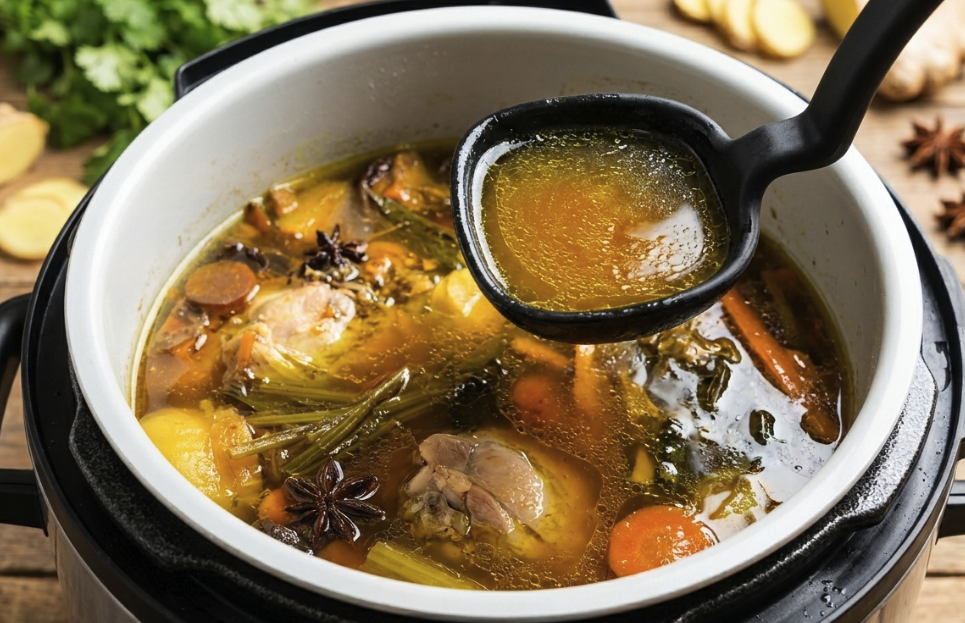
There are few things more useful in the kitchen than a good stock. It sits quietly in the background, but it changes everything.
This Asian-style chicken stock is built from simple ingredients: a chicken frame, vegetable offcuts, aromatics and water. The Ninja pressure cooker does the heavy lifting, extracting flavour quickly and giving you a beautiful base that is far more fragrant and useful than most supermarket stocks.
No mystery ingredients. No “nasties”. Just proper flavour.
1. Place the chicken frame into the Ninja cooking pot.
2. Add the onion, carrot, celery offcuts, coriander, star anise, ginger, turmeric and lemongrass.
3. Pour in the water, making sure you do not exceed the maximum fill line of your machine.
4. Secure the lid and set the Ninja to pressure cooker mode.
5. Cook for 1 hour and 45 minutes.
6. Once cooked, allow the pressure to release safely according to your machine’s instructions.
7. Carefully strain the stock through a fine sieve or chinois into a clean container.
8. Discard the solids.
9. Cool the stock as quickly as possible. For food safety, it needs to come down to below 5°C within 2 hours.
10. Once chilled, portion into containers.
11. Store in the fridge for 5–7 days, or freeze for 2–3 months.
This is where your kitchen starts working smarter.
A chicken frame that may have been thrown away becomes the base for soups, curries and sauces. Vegetable offcuts that might normally go in the bin become flavour. Ginger, turmeric, lemongrass and star anise give the stock a beautiful Asian-style aroma without making it too heavy or overpowering.
The Ninja pressure cooker is a great shortcut here because it extracts flavour quickly. Traditionally, stock would simmer gently for hours, but pressure cooking gives you great depth in much less time.
No pressure cooker? No problem. This can also be made in a stockpot on the stove. Just allow 6–8 hours of gentle simmering to extract the full flavour.
When using fresh ginger and turmeric, don’t let the leftovers dry out or go mouldy in the fridge. Slice them up, place them in a zip-lock bag, and freeze them. They are perfect for adding straight into stocks, soups, curries and broths.
It saves waste, saves money, and means you always have flavour on hand when you need it.
When cooling stock, don’t leave it sitting on the bench for hours. Portion it into smaller containers so it cools faster, or place the container over an ice bath before refrigerating.
Stock is one of the first things chefs learn because it teaches an important lesson: flavour is built in layers.
The chicken frame gives body.
The vegetables give sweetness.
The coriander adds freshness.
The ginger and turmeric add warmth.
The lemongrass adds fragrance.
The star anise adds that gentle aromatic background.
None of these ingredients need to shout. Together, they create balance.
That is what good cooking is about.
If you don’t have a pressure cooker, this stock can absolutely be made the traditional way in a stockpot on the stovetop.
Place all ingredients into a large stockpot, bring gently to a simmer, then reduce the heat and allow it to simmer slowly for 6–8 hours.
The key is a gentle simmer, not a hard boil. This gives the chicken frame and aromatics time to release their flavour and creates a cleaner, better-balanced stock.
Top up with a little extra water if needed during cooking.
For a cleaner, lighter stock, leave out the turmeric.
For a stronger Asian broth, add more ginger and lemongrass.
For a richer stock, roast the chicken frame first before pressure cooking.
For a slightly Japanese-style base, add a small piece of kombu after cooking while the stock is still hot, then remove it before chilling.
For a more savoury finish, add a splash of soy sauce or fish sauce only when using the stock in the final dish, not during the stock-making stage.
Supermarket stocks can be useful, but they often lack depth. Some are salty, some taste flat, and some contain ingredients you may not really want or need.
Making your own stock gives you control. You decide what goes in. You control the salt. You build flavour from real ingredients.
And once you have a few portions in the fridge or freezer, weeknight cooking becomes much easier.
A simple soup suddenly tastes better. A curry has more depth. A sauce has more body. Even rice cooked in this stock instead of plain water takes on another level of flavour.
This is not fancy cooking. This is foundation cooking.
This stock is ideal for:
Asian-style soups
Laksa-style broths
Thai curries
Japanese noodle bowls
Poaching chicken or seafood
Sauces and reductions
Rice or noodle dishes
Quick weeknight flavour boosts
Use it anywhere you would normally reach for supermarket chicken stock, especially when you want a cleaner, fresher and more fragrant flavour.
